

Rail industry gets on board for Samaritans’ campaign.
British reserve may be internationally renowned but a new survey by Samaritans shows how much we rely on small talk as a nation, even with the limiting social restrictions of the pandemic. The findings come as Samaritans launches a new phase of Small Talk Saves Lives this summer, in partnership with Network Rail, British Transport Police and the wider rail industry, to empower the public to act to prevent suicide on the railways and other settings.
The YouGov survey found that over three quarters of UK adults (78%) used small talk during the pandemic, whilst almost one in five of those surveyed say they are likely to want to make more small talk with a stranger face to face once restrictions are lifted (19%). Just over half of those who want to make more small talk said it was because they now recognise the importance of human connection (51%) and with 39% of respondents saying they also appreciate the sense of community the pandemic brought out in people.
Despite the unprecedented events of the last year, the good old British weather still remains the go-to subject for striking up conversation, chosen by 71% of people, compared to coronavirus in second place with 45%.
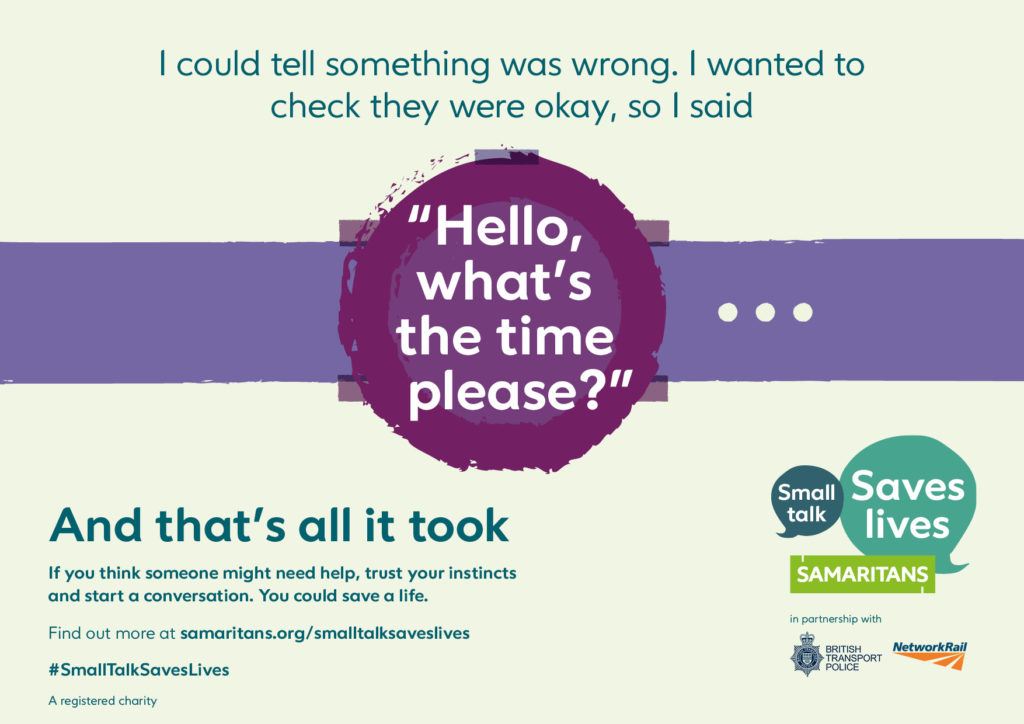
After an incredibly tough year and as the nation begins to readjust to life with easing restrictions, the campaign reminds the public they already have the skills to start a conversation with someone who needs help, giving them the confidence to act. By trusting our instincts, if something doesn’t feel right, a little small talk and a simple question, such as “Hello, what’s the time?” can be all it takes to interrupt someone’s suicidal thoughts and help start them on the journey to recovery. It could save a life.
The survey also highlighted the benefits small talk can have, with over half of respondents saying it can make people feel less lonely (57%) and boost their own mental health and wellbeing (45%), as well as showing others that people care and want to help them (28%).
Network Rail’s Dom Mottram, age 32, knows the importance of small talk after he experienced suicidal thoughts aged 19 and was considering taking his life when a lady approached him and asked him a question – her kindness “snapping him out of harming himself in the moment”. Dom has since helped others in a similar situation both in and out of the rail environment.
Dom said: “I’m thankful for the ripple effect of that lady saving my life – without her stopping and checking if I was okay, I might not be here to now look out for and save others. I’m always on the lookout for anyone who might need help. If I see someone who looks out of place or a bit down, I often just go over and ask if they’re alright and try and bring them to a place of safety. Nine times out of ten the person is absolutely fine – but trusting my instincts and talking to that one person can make such a difference.
“It took me a long time before I spoke to anyone about that moment – but it was a wake-up call and I eventually got help from the university and my family. I’ve had my ups and downs with my mental health after that, but I’ve come a long way since my 19-year-old self and feel I know how to support my mental health now. I’d encourage everyone to talk about how they’re feeling and ask for help. It’s so true that small talk is enough to save someone’s life – just as it did for me and it’s what I always try to do for others.”
Samaritans CEO Julie Bentley said: “We know that the pandemic has had a huge impact on the nation’s mental health and wellbeing and even though restrictions are lifting, people are still struggling. It’s so important we look out for one another now more than ever, because suicide is preventable and it’s everybody’s business.
“How people act when they are struggling to cope is different for everyone – people may seem distant or upset, but suicidal thoughts are often temporary – so if something doesn’t feel right, trust your instincts and try and start a conversation. Whether that’s on a journey home from work as we start to travel more or someone you may pass in the street – any one of us could have an opportunity to save a life. Let’s start a conversation and work together to prevent suicide.”
Initially launched in 2017, Small Talk Saves Lives was developed after research showed passengers have a key role to play in suicide prevention. The latest phase of Small Talk Saves Lives has the backing from leading suicide prevention expert and psychologist, Associate Professor Lisa Marzano, from Middlesex University. Further new research from Marzano has confirmed that when asked, people with experience of suicidal thoughts said that verbal interventions, including small talk, providing reassurance and listening, are the most helpful things a person can do to respond to someone in a crisis.
Sheila’s small talk helps save a life
Huddersfield-based railway colleague, Sheila Anderson, has made an intervention to save someone’s life after feeling empowered to apply the skills she learnt through Samaritans’ training with Network Rail.
Sheila, a Learning & Development Administrator, has worked for TransPennine Express in Huddersfield for six years and took part in Samaritans’ ‘managing suicidal contacts’ training with Network Rail, as part of the rail industry partnership.
In early 2020, Sheila was heading out for her weekly food shop, when she saw someone who needed help – trusting her instincts, she struck up a conversation and managed to get them the help they needed.
Sheila said: “Around the beginning of last year, I was on the way to my weekly shop when I came across a young woman in floods of tears. I had taken part in Samaritans’ Managing Suicidal Contacts training over four years ago, wbut something inside me told me something was wrong, so I stopped the car and slowly approached her. I asked, “has something happened to bring you here today?” and I could tell that instantly broke her thoughts. She told me her name and said she was struggling to cope as she wasn’t able to get the support she needed.
“I then encouraged her to move to somewhere quieter to get her to a safer place and she asked me to call the hospital she was at. Another woman stopped and kindly offered to help. She hugged the young lady and made small talk, whilst I arranged for an ambulance.
“I’d encourage everyone, if they see someone who needs help, just say anything – anything that’s going to break that cycle of thought. Even though I was lucky enough to have Samaritans’ training in the rail industry, I think I’m quite an observant and caring person and since that experience I’m even more hyper-sensitive and would do the same again in a heartbeat.”
Network Rail offers this training by Samaritans to give rail staff the skills they need to help identify vulnerable people and get them to a place of safety. Over the past 10 years, the partnership has trained over 23,000 rail and BTP staff to look out for passengers and make conversation if they feel someone might be vulnerable.
The campaign is a reminder that, like Sheila, everyone has the skills to start a conversation with someone who needs help. By trusting our instincts, if something doesn’t feel right, a little small talk and a simple question, such as “Hello, what’s the time?” can be all it takes to interrupt someone’s suicidal thoughts and help start them on the journey to recovery. It could save a life.