

The railway is adapting to a new challenge as increasingly frequent periods of extreme heat test infrastructure, operations, and resilience across the network.
If you haven’t noticed the warmer weather over the past few months, you must be living in a different country. Presumably a cool one. Between May and August, this summer’s multiple heatwaves broke records and tested the will of the nation.
Britain’s rail network has always contended with the elements, whether that’s autumn leaves affecting adhesion or winter cold snaps bringing snow and ice. The railways are also equipped to handle our hottest summers, and all the problems they bring.
Increasingly, however, extreme heat associated with climate change is presenting a new and growing challenge, and the summer of 2026 has provided a stark demonstration of what that means.
This year’s exceptionally high temperatures and prolonged dry weather have contributed to problems ranging from track and ground movement to lineside fires, sagging overhead lines, and overheating signalling and electrical equipment. These have prompted speed restrictions, amended timetables, and major engineering interventions.
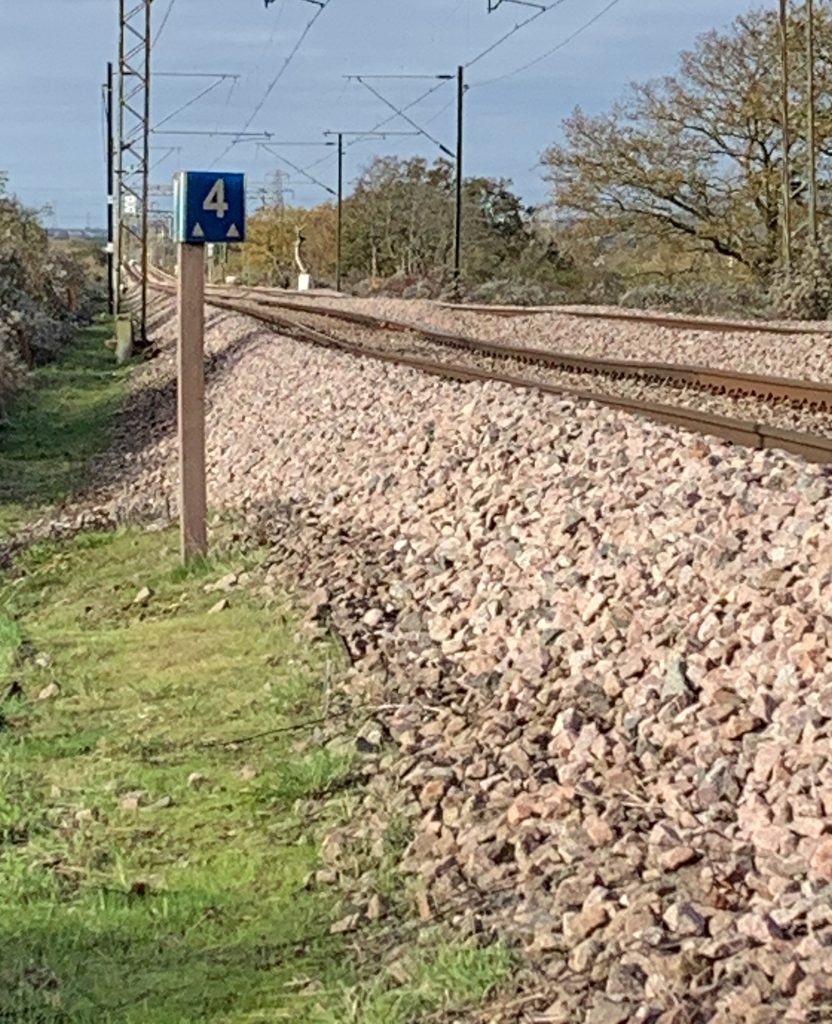
The challenge is no longer to simply prepare the railway for an occasional hot spell. Climate change is forcing the industry to consider how infrastructure designed around historical weather patterns can remain safe and reliable as those patterns change.
Shifting ground
One of the most recent examples was seen in Essex in late August, when prolonged heat and low rainfall caused clay beneath sections of the railway to dry out and shrink. The resulting changes in ground conditions affected track quality, prompting GBR Anglia to introduce speed restrictions and temporary timetable changes on c2c services.
The measures were intended to provide greater certainty for passengers while reducing the risk of short-notice disruption, but they also demonstrate a fundamental challenge posed by extreme heat: the impact is not necessarily confined to the rail itself. The conditions surrounding the track can be just as important.
To counter the effect of dried-out soil, Network Rail engineers have been working over the summer using tampers to help create a more stable track foundation and installing new ballast to help restore track levels.
Last year, around 100km of track affected by dried-out soil was treated using tampers. In preparation for this summer, thousands of tonnes of ballast were delivered, with 49,000 tonnes expected to be dropped across Anglia alone.
Battling buckling
The most familiar heat-related risk to the railway is rail buckling. As temperatures rise, steel rails expand, increasing pressure within the track. Rails can become as much as 20°C hotter than the surrounding air and, if that pressure becomes too great, the track can distort or buckle with serious implications for safety.
The industry uses a range of measures to manage this risk, including identifying vulnerable sections of track before summer, painting ‘hot spots’ white to reduce heat absorption, using sensors to monitor rail temperatures, and introducing speed restrictions when necessary.
The latter can be frustrating for passengers, but there is a clear safety calculation behind these measures. Slowing trains during the hottest periods reduces the stresses placed on infrastructure and can prevent a localised problem becoming a line closure.
Network Rail has also been expanding its use of remote temperature monitoring. Sensors provide more frequent and accurate information about rail temperatures, allowing restrictions to be targeted at sections where they are needed rather than applying blanket measures across larger areas.
The same principle applies to overhead line equipment (OLE), where high temperatures can cause overhead lines to expand and sag. Modern systems with automatic tensioning can compensate for changes in temperature, making them less vulnerable, while older fixed-tension equipment is more susceptible to heat. Network Rail adjusts the height and tension of older equipment during summer and is replacing it with more resilient systems where appropriate.
Extreme heat also places pressure on signalling equipment. Network Rail says internal temperatures within signalling cabinets can exceed 70°C during excessive heat, increasing the risk of equipment failure. It has been trialling cooling technology capable of reducing peak cabinet temperatures by more than 21% on the hottest days.
The fire risk
Dry vegetation alongside the railway can become highly combustible during prolonged periods without rain. The consequences can extend well beyond the immediate fire, particularly where signalling, telecommunications, drainage, fencing or other infrastructure is damaged.
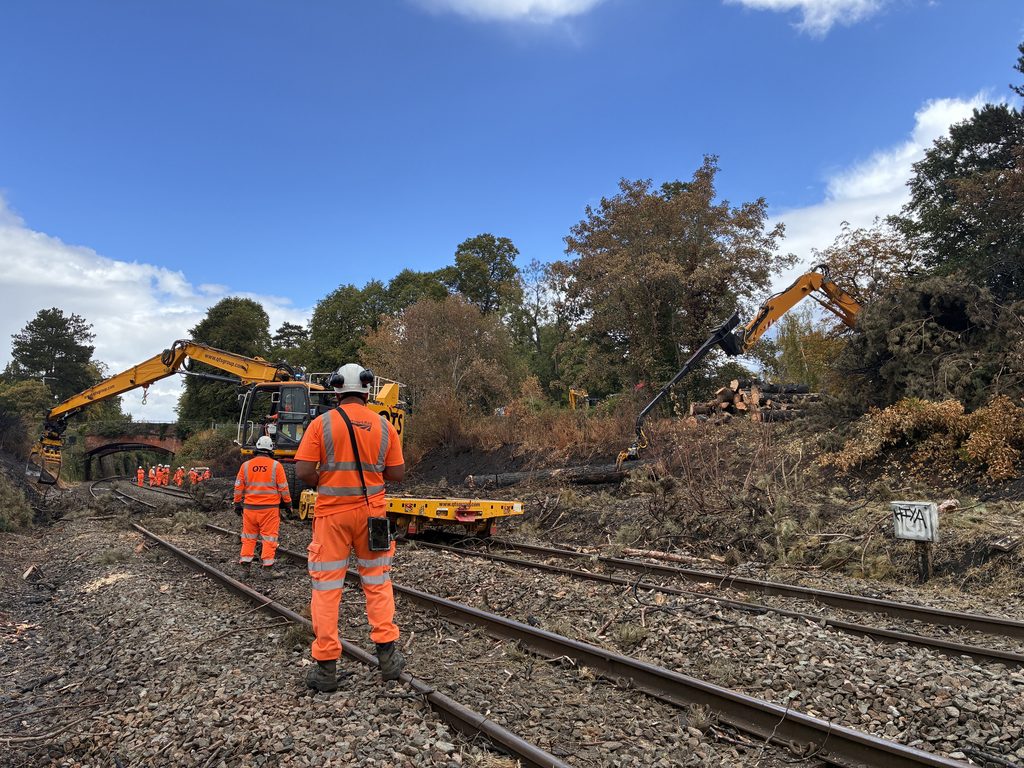
Events in Stourbridge this month provided a particularly striking example of the potential consequences of a lineside wildfire. Wildfires that began on 13 August caused extensive damage to the railway between Stourbridge Junction and Hagley. Signalling equipment, telecommunications systems, drainage, fencing, and neighbouring trees were all affected.
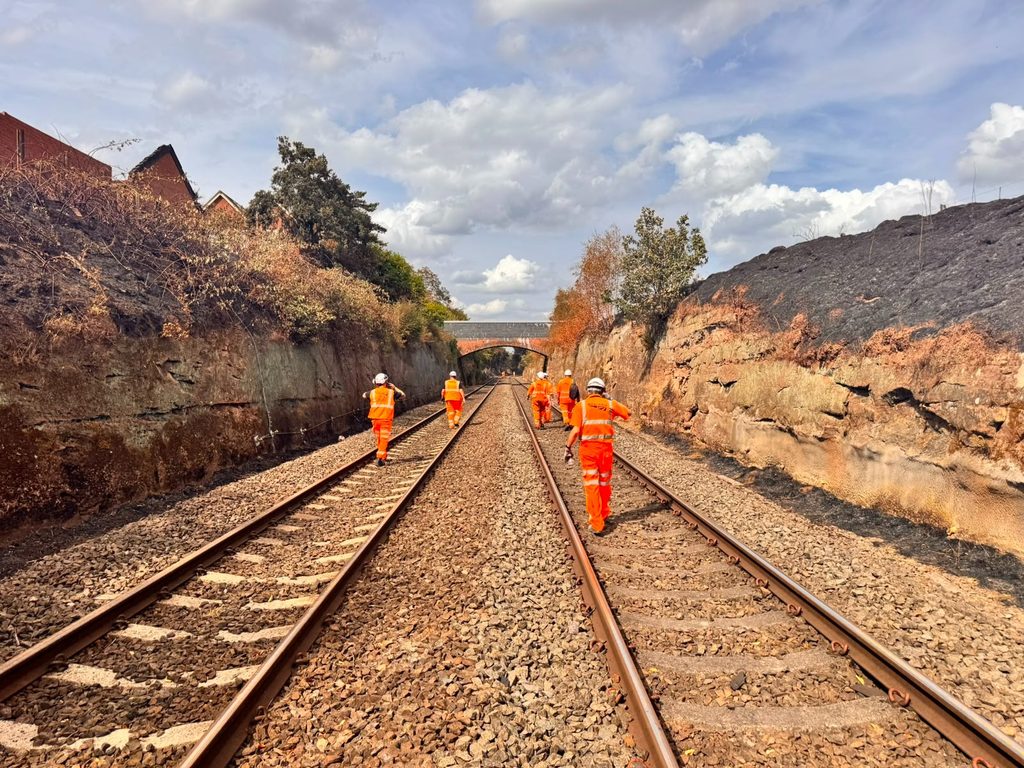
More than 200 railway staff were subsequently involved in the recovery operation, including engineers, technical specialists, arborists, signallers, planners and operations teams. More than 3,000 metres of signalling power and data cables and 1,500 metres of fencing and boundary protection had to be replaced, while drainage channels, signalling components, and other infrastructure also required repair.
The line reopened on 22 August following more than a week of round-the-clock recovery work, although further repairs to fencing and drainage were expected to continue.
The Stourbridge incident illustrates how a lineside fire can quickly become a major railway incident, requiring infrastructure, operations, engineering and supply-chain teams to work together to restore the railway.
From reaction to prediction
The industry’s response is increasingly focussed on predicting where problems will occur rather than waiting for them to happen.
Network Rail established its Extreme Heat Task Force in 2022 following record temperatures that caused significant disruption. Its work resulted in 91 recommendations covering engineering, weather forecasting, operations, and passenger communications. One of the key conclusions was that the railway needed to become less reactive, using forecasts to identify risks, plan the service it wants to operate, and deploy resources before infrastructure fails. That philosophy is now becoming embedded in the way the railway prepares for extreme weather.
Network Rail says its climate adaptation work includes upgrading infrastructure, installing equipment capable of withstanding higher temperatures, and developing long-term adaptation pathways. Its long-term ambition is to have prepared railway infrastructure to minimise the impacts of climate change by 2050.
This reflects a broader change in the way the railway must think about resilience. Historically, extreme heat was treated as a seasonal operational risk. Increasingly, it is becoming an infrastructure design and asset-management issue.
Preparing for the future
Inevitably, there is no single engineering solution to the problem of extreme heat events. The railway has to deal with the interaction between temperature, rainfall, soil conditions, vegetation, and the age of infrastructure. That makes monitoring and early intervention particularly important.
It also means that the industry’s response cannot stop when temperatures return to normal. Network Rail’s work on climate adaptation is intended to look beyond individual heatwaves and assess how infrastructure needs to change over the longer term.
The National Railway Museum’s Summer Rail Garden, developed with Network Rail, offers a surprisingly useful illustration of this shift. The installation explains how heat and drought can affect rails, ground conditions, overhead lines, signalling equipment and vegetation, while highlighting some of the technologies and engineering measures being developed to make the railway more resilient.
For railway professionals, however, the issue is considerably more consequential than an educational exhibit might suggest. The question facing the industry is how to maintain a railway that was largely engineered around a climate that is no longer the one it operates in.
Network Rail’s response is increasingly based on a combination of monitoring, maintenance, investment, and adaptation. Speed restrictions remain an important safety tool, but the longer-term objective is to reduce the need for them by making infrastructure more capable of withstanding extreme conditions.
The experience of summer 2026 indicates that this work is becoming less of a future consideration and more of an immediate operational necessity.
For Britain’s railway, adapting to climate change is no longer simply about preparing for the next heatwave. It is about ensuring that today’s infrastructure, technology, and working practices are capable of keeping people and freight moving safely as extreme weather becomes an increasingly normal part of the railway’s operating environment.
Image credit: Network Rail